
You sent 200 ARCs and got 14 reviews. It's not your book - it's your list.
It's launch week. You did everything right. You built a list, you sent the advance copies, you wrote the sweet reminder email with the little thank-you GIF. Then you sat down on release day, refreshed your Amazon page, and counted. Fourteen reviews. Out of two hundred copies.
And here's the thought that keeps you up that night - the one nobody says out loud: maybe the book just isn't good enough. Maybe two hundred people read it and quietly decided it wasn't worth two sentences.
Stop right there. That number almost never means what you think it means. The problem isn't your prose, your cover, or your tropes. The problem is that your ARC list is leaking readers at every single step between "yes, I'll take a copy" and "review posted" - and until you can see whereit leaks, you'll keep blaming the wrong thing launch after launch. This is how you find the leak, and how you build a reader roster that actually shows up.
The two hundred copies that were never really two hundred
Let's do the math nobody wants to do. You didn't send two hundred reviews into the world. You sent two hundred invitations, and an invitation to accept a free book is one of the lowest-commitment things a human being can say yes to. Watch where the people go:
- A chunk accept the copy and never download it.
- Of the downloaders, a chunk never open the file.
- Of the readers, a chunk finish the book and never post.
- Of the posters, some review on Goodreads but not the Amazon page your launch actually needed.
- And a quiet, persistent slice were never going to review at all - they collect free books the way other people collect tote bags.
Stack those drop-offs on top of each other and a low review rate on a cold, unvetted list is not a tragedy. It's arithmetic. What should bother you is the other end of the range: campaigns run with a deadline, a reminder sequence, and a record of who followed through are measured at roughly 38–75% of downloads, and readers invited from an author's own list have hit 93% on a platform where strangers managed 72%. The numbers and their sources are in what the data actually says about ARC review rates. The authors posting fifty, eighty, a hundred reviews on release day did not write more lovable books than you. They stopped spending copies on people who were never going to show up. That's the whole trick. Everything below is how you get there.
The real villain: your spreadsheet has amnesia
Here's the quiet frustration at the center of ARC management, and it has a name: your tracking resets every book.
Most indie authors run their ARC campaigns out of a spreadsheet that gets duplicated, renamed ARC_LIST_BOOK4_FINAL_v2, and started fresh every release. Which means every single launch, you walk up to the same casting decision with total amnesia. You re-invite the reader who took a copy of your last three books and reviewed exactly none of them - because the tab that remembered that got left behind two launches ago. You have no way to tell the difference between a first-time reader who had a genuinely rough month and a serial freeloader on their fifth free copy.
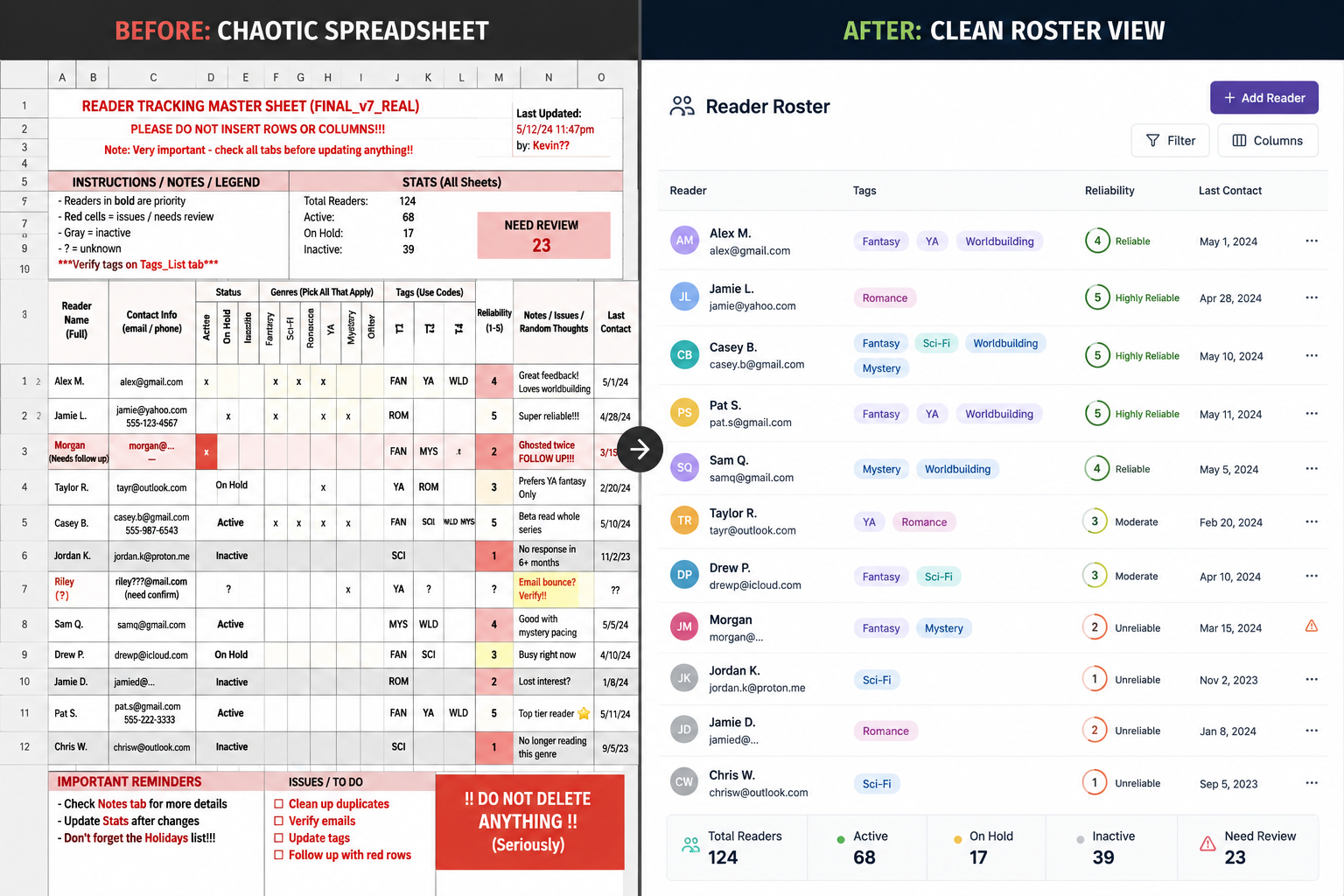
So you make the same expensive mistake over and over. You pour your best copies - the ones with the highest chance of turning into a launch-day review - into a bucket with a hole in it, and you never even see the hole, because next launch you get a brand-new bucket. We wrote a whole piece on why ARC readers ghost and what actually reduces it, but the one-sentence version is this: the fix isn't a better reminder email. It's memory.
What actually fixes it: stop renting readers, start building a roster
Every launch, indie authors quietly rent an audience. You lean on a shared reviewer pool, or a Facebook ARC group, or whoever raised their hand this time - and when the launch ends, the relationship evaporates. Next book, you start from zero and rent again.
The authors who compound - whose review numbers climb book over book instead of restarting at the bottom - do the opposite. They treat their reviewers like the asset they actually are: a roster they own. A living list of real people, carried across every launch, that gets smarter every time they use it.
That's the entire idea behind ArcRoster. It's ARC management built for indie romance, fantasy, and thriller authors who are done running their most important launch asset out of a spreadsheet with no memory. Instead of a list that forgets, you get a roster that learns.
How it plugs each leak
1. Recruit readers into something you own
Instead of chasing sign-ups through a dozen scattered DMs and a Google Form, you get a public application page readers can find and sign up through directly. New readers flow straight into your roster with the tags and notes you want - not a fresh, contextless spreadsheet row. Your audience becomes yours, not the platform's. (If you're starting from nothing, our guide on building an ARC team from zero is the place to begin.)
2. Give every reader a reliability score that remembers
This is the heart of it. Every reader on your roster carries a living reliability score that goes up when they download and review on time, and down when they take a copy and vanish - while pointedly not punishing readers who simply never started, because those two behaviors are not the same crime. Run a few launches and something quietly wonderful happens: your list sorts itself. The top of your roster becomes the readers who genuinely show up, and the collectors drift to the bottom where they belong.
3. Keep a reviewer CRM, not a graveyard of tabs
Every reader gets a persistent profile with their history, your private notes ("adores enemies-to-lovers, hates cliffhangers"), and tags you can filter by. Next launch, you're not staring at a blank sheet - you're casting from a roster you know. The reader who left a gorgeous four-paragraph review of your last thriller is right there, flagged, ready to invite first.
4. See the whole campaign in one dashboard
No more counting reviews by hand at midnight. Campaign tracking shows you, live, who was invited, who downloaded, who reviewed, and who's about to blow the deadline - so you can send the one reminder that matters to the readers who genuinely just forgot, instead of guilt-tripping the whole list.
5. Fingerprint every copy so your terms actually mean something
Here's the leak that stings the most - the literal one. Every copy you send can carry an invisible EPUB fingerprint, unique to the reader who received it. If your unreleased book turns up on a piracy site, you can trace the leak back to a name and act on it. "Please don't share this" stops being a polite hope and becomes something enforceable. (New to the terminology? Here's the difference between watermarking, fingerprinting, and DRM, and here's exactly what to do the day an ARC leaks.)
What this looks like from the author's chair
Picture two versions of the same author, three books apart.
Launch one: she blasts a copy to everyone who'll take one, crosses her fingers, and counts reviews by hand on release day. It hurts.
Launch four: she opens her roster, sorts by reliability, and invites the top of her list first - the readers who've shown up three times running. She watches downloads and reviews roll in on a dashboard instead of refreshing Amazon. Her release-day review count isn't a lottery anymore. It's a number she can roughly predict before she hits send.
Nothing about her writing changed between those two launches. Her casting did. That's the transformation - from spraying free books at strangers and hoping, to launching to a known, ranked, owned audience that gets more reliable every time you use it.
Why not just use a shared reviewer pool?
Tools like Booksprout and StoryOrigin do a real job, and for some authors a shared reviewer pool is a fine on-ramp. But a borrowed pool has a ceiling built into it: the readers aren't yours, the reliability history isn't yours, and every author in the pool is competing for the same tired reviewers. You can't build compounding trust with people you don't keep.
ArcRoster is built on the opposite bet - that your reviewer relationships are an asset worth owning and compounding, not renting by the launch. If you're weighing the options, we lay them out honestly in our ARC tool comparison and a head-to-head on Booksprout vs StoryOrigin.
Why now
Two things make this the moment to fix your ARC process instead of limping through one more launch. First, review-manipulation crackdowns and shifting retailer rules mean scattered, unverifiable reviewer lists are more of a liability than ever - you want readers you know are real and reliable. Second, piracy of advance copies is getting faster and more automated; an un-fingerprinted ARC is a copy you can't defend. The authors who get ahead of both aren't working harder. They're working from a roster.
Getting started (it takes an afternoon, not a rewrite)
- Request a beta invite - the beta is invite-only. There's a free plan to start on, and if you upgrade while you're in the beta you keep 20% off for life.
- Spin up a recruitment page and point your existing readers, newsletter, and social followers at it.
- Import or rebuild your roster once - the last time you'll ever start from a blank sheet.
- Run your next launch through it, fingerprint every copy, and let the reliability scores start doing their quiet sorting.
- Launch again - and this time, cast from the top of a list that remembers.
You don't have to overhaul anything. You just have to stop handing your best copies to a bucket with a hole in it.
The bottom line
Fourteen reviews out of two hundred was never a verdict on your book. It was a symptom of a list that forgets - that re-invites ghosts, can't tell a busy reader from a freeloader, and starts from zero every launch. Give your reviewers a memory. Give your copies a fingerprint. Build a roster you own instead of an audience you rent, and watch your release-day numbers stop being a coin flip.
Your next launch can be the last one you count by hand. Join the ArcRoster beta free and start building the roster that shows up.
About ArcRoster
ArcRoster is an ARC management platform built specifically for indie romance, fantasy, and thriller authors - the people running reader teams of twenty to five hundred, launch after launch. We're obsessed with one idea: that the reviewers who show up for you are an asset worth owning, scoring, and protecting. We write these guides for working authors, not search engines. Come build your roster with us.